Introduction
Becoming a teacher in Tripura is the dream of many people. It is a noble profession and a very respectable position. They are the backbone of Indian society. A teacher plays an important role in building a student’s life. From the physical to the mental, to the social, to the psychological, the teacher plays an important role in their career.
If you go back and analyse your life, you will see that your teacher’s role in guiding your career plays one of the most important parts. This is not just a job but an important role in building your nation. So, I hope that if you are planning to become a teacher in Tripura, it is not just a government job, but your passion to be a teacher.
Recently, the Government of Tripura has recruited many teachers under TRBT. TRBT releases vacancies for graduate teachers and post-graduate teachers. In this article, we will discuss how to become a teacher (Graduate or Post-Graduate) in Tripura from scratch.
Types of Teaching Posts in Tripura
In Tripura, the position for a teacher is divided into a few categories based on class and qualification. If you want to teach from class one to eight, then you need a separate qualification for teaching in classes nine to twelve. So, before becoming a teacher, you need to understand the categories that the government of Tripura has divided class-wise. Below are the details,
Class I-VIII
To become a teacher from class one to eight, you need to have completed D.Ed after passing the 12th standard. After that, you need to pass the qualified T-TET examination conducted by the TRBT from time to time.
Class IX-X
This is known as a graduate teacher. TRBT recruits for this post by conducting the STGT (Selection Test for Graduate Teacher).
To be eligible for this post, you need to have graduated/post-graduated from a recognized University with at least 50% marks in either Graduation or post-graduation (or its equivalent) and a Bachelor of Education (B.Ed) from a National Council for Teacher Education-recognized institution
For classes XI–XII
This is the most demanding position as a teacher in Tripura. Everyone wants to become a postgraduate teacher as this is the most respected position, and the salary is high compared to the above two.
TRBT recruits for this position by conducting an STPGT (Selection Test for Post Graduate Teacher) test.
The minimum qualification to sit for the examination of STPGT is a graduate/post-graduate from a recognised University with at least 50% marks in either Graduation or post-graduation (or its equivalent) and a Bachelor of Education (B.Ed) from a National Council for Teacher Education-recognised institution.
Eligibility Criteria
As we all know, teaching is a very responsible job, and it requires special training to become a teacher. As a teacher, you are building the future of our nation. For this, a special diploma or degree programme is designed to make one eligible to become a teacher.
The names of the courses are Diploma of Education (D.Ed) and Bachelor of Education (B.Ed). After 12th, you can take admission for D.Ed., and after graduation, you can complete B.Ed. from any recognised university.
After completing your B.Ed. or D.Ed. You are qualified to become a teacher. Now the question arises: how? After completing B.Ed., can you become a teacher in,
- Private school- By clearing a written test or interview, which will be conducted by the respective schools.
- Government School- By clearing STGT, STPGT, or T-TET conducted by TRBT.
How to do B.Ed. in Tripura
Many candidates, after passing 12th and completing their graduation, have no idea how to become a teacher. And those who know are confused about how and from where to do their Best degree
Here we will clear all your doubts.
1. If you are planning to do your best just after completing 12th, then you can take admission in any college from the ones mentioned below. In this case, you will only be eligible for a primary school teacher. The name of the course is D.Ed. We don’t recommend this to you, but this is one option available, so we mentioned it.
2. You can also do your B.Ed. after graduation. The process is the same, and all of the listed colleges take admission for bed after graduation. We highly recommend this to everyone. If you have a degree in science, then you will become a science teacher for classes IX to X.
3. To become a teacher for classes 11th and 12th, you need a master’s degree after graduation from a recognised university.
Exams You Need to Clear
Ok, now you have all the required qualifications to become a teacher. Wait for the notification from TRBT for the recruitment process.
TRBT releases a notification for the recruitment of primary teachers by T-TET (Paper 1 and Paper 2), graduate teachers, and post-graduate teachers.
- For the Primary teacher, the T-TET exam will be conducted. For classes one to five, the Paper 1 exam is conducted, and for classes six to seven, you need to clear Papers 1 and 2.
- A Graduate teacher means for classes IX-X, the STGT exam is conducted for classes IX-X.
- Similarly, for classes eleven to twelve, the STPGT exam is conducted by TRBT.
- For physical education, the STPET (Selection Test for Physical Education Teacher) tests will be conducted
- For the special educator, the Special Educator (STPE) is organised.
Mainly, these are the exams conducted by the TRBT from time to time. Based on your interest and qualifications, you apply for the vacant post.
Exam Pattern of TRBT
It is important to understand the exam pattern before you start your preparation. Well, the exam pattern of the TRBT recruitment process is very simple.
For the T-TET paper, paper 1 is conducted for 150 marks, and paper 2 is also for 150 marks in total. Out of which 50% marks are the qualifying marks to get selected in the merit list.
STGT and STPGT each include one paper of 150 marks, and candidates must score at least 50% to qualify for the
Step-by-Step Process to Become a Teacher in Tripura
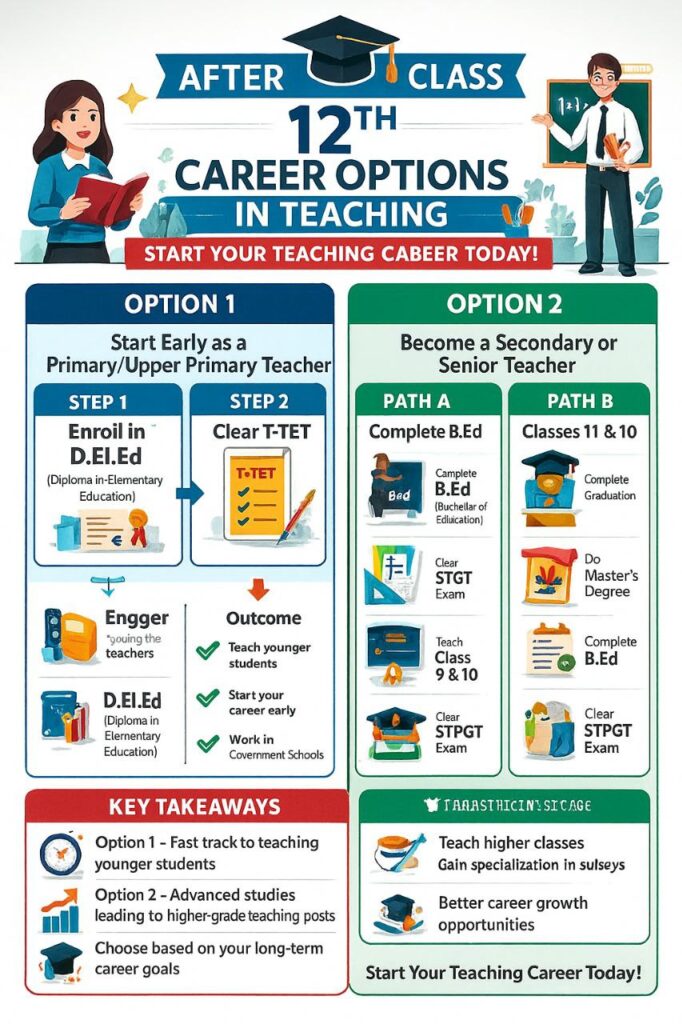
Here, I have provided a summary of the step-by-step process to become a teacher in Tripura, starting from class 12th.
Option 1 – Start Early as a Primary/Upper Primary Teacher
➡️ Step 1: Enrol in D.El.Ed (Diploma in Elementary Education)
➡️ Step 2: Clear T-TET (Teacher Eligibility Test)
Paper 1: Eligible for Class 1 to 5
Paper 1 & 2: Eligible for Classes 5 to 8
Outcome:
✔️ Teach younger students
✔️ Start your career early
✔️ Work in government schools
Option 2 – Become a Secondary or Senior Teacher
➡️ Path A – For Classes 9 & 10
- 1. Complete B.Ed (Bachelor of Education)
- 2. Clear STGT Exam
- 3. Teach Class 9 & 10
➡️ Path B – For Classes 11 & 12
- 1. Complete Graduation
- 2. Do a Master’s Degree
- 3. Complete B.Ed
- 4. Clear STPGT Exam
- 5. Teach Class 11 & 12
Outcome:
✔️ Teach higher classes
✔️ Gain specialization in subjects
✔️ Better career growth opportunities
Salary, Perks & Growth Opportunities
Now comes the main part: the salary of a TRBT teacher in Tripura. Initially, recruitment is done on a fixed pay basis. The salary varies by post, starting from Rs 16,000 to Rs 26,000.
Primary teacher- Rs 16,000/month.
For Graduate Teacher- Rs 20,000/month
For Post Graduate Teacher- Rs 26,000/month.
The first 5 years will be on a fixed pay basis; in this period, a teacher will get 75% of their actual salary. After completion of 5 years, you will be treated as a regular employee and will get the full benefits of a regular employee.
Conclusion
This is the full process of becoming a teacher in Tripura. It is very easy to clear the TRBT exam if you have a B.Ed degree. If you are passionate about teaching, I suggest you do a B.Ed. degree and clear the exams conducted by the TRBT. Teaching is the most respected profession in our country, and teachers are the backbone of the nation.