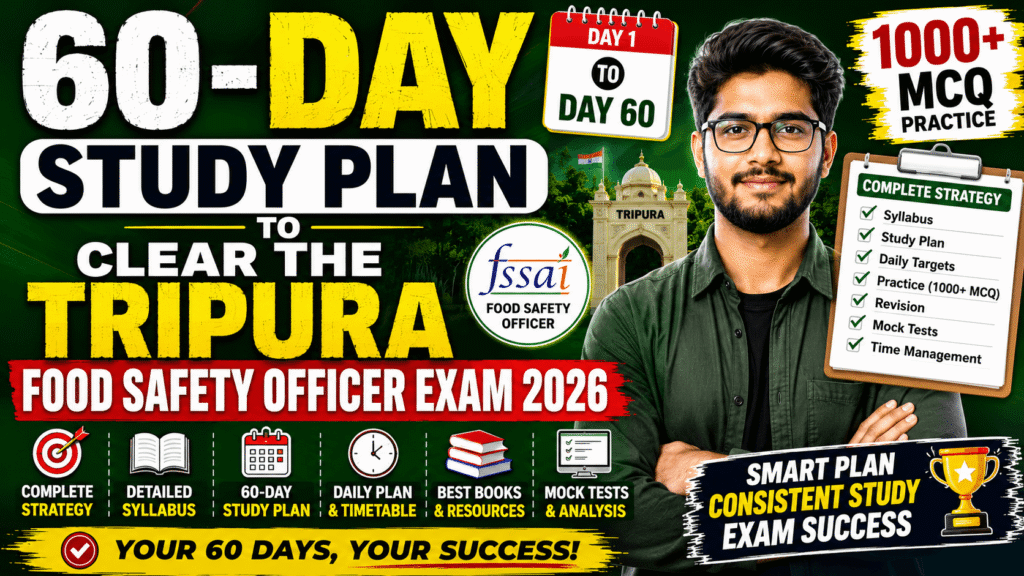
Preparing for the Tripura Food Safety Officer (FSO) Exam 2026 may feel difficult due to its extensive syllabus, especially if you are a non-food graduate, i.e., BHMS, BAMS, MBBS. With the right strategy and consistency, it is absolutely possible to crack this exam in just 60 days.
In this article, I will provide a day-wise study plan, smart preparation tips, and revision techniques to help you cover the entire syllabus effectively and maximize your chances of success.
Whether you are a beginner or a repeat aspirant, this 2-month or 60-day strategy will keep you focused, disciplined, and exam-ready.
Before going into the study plan, I suggest you review the detailed syllabus. It will build a better understanding of the Tripura FSO exam.
In this detailed guide, you’ll learn:
- Latest Tripura Food Safety Officer Exam Pattern
- Complete syllabus
- Best books and study resources
- 60-day preparation strategy
- Daily study timetable
- Revision plan
- MCQ practice strategy- 1000 MCQ Set
- Common mistakes to avoid
- FAQ
Who is a Food Safety Officer?
A Food Safety Officer (FSO) is responsible for ensuring that food sold or manufactured is safe for public consumption. After joining as an FSO, your duty will be in the office, and aslo you also have to visit different local food shops to ensure the best quality of food for the public.
Their responsibilities include:
- Inspecting food businesses
- Collecting food samples
- Checking food quality
- Ensuring compliance with the Food Safety and Standards Act
- Preventing food adulteration
- Creating awareness regarding food hygiene
Tripura Food Safety Officer Selection Process
Generally, the recruitment process consists of:
- Written examination ( 85marks)
- Interview (15 marks)
Complete Tripura Food Safety Officer Syllabus
This is one of the most important sections.
Study topics like:
- FSS Act 2006
Food Safety Rules
Licensing
Registration
Food Business Operators
Food Recall
Food Labeling
Packaging
Food Additives
Contaminants
Enforcement Procedures
Food Import Regulations
- Food Microbiology
- Bacteria
- Viruses
- Fungi
- Yeast
- Mold
- Foodborne Diseases
- Food Poisoning
- Sterilization
- Pasteurization
- Fermentation
- Water Quality
3. Focus on diseases caused by:
- Salmonella
- E. coli
- Listeria
- Clostridium
- Staphylococcus
4. Food Chemistry
- Carbohydrates
- Proteins
- Lipids
- Vitamins
- Minerals
- Water Activity
- Food Additives
- Food Colors
- Food Preservatives
- Enzymes
5. Food Technology
- Food Processing
- Food Preservation
- Canning
- Drying
- Refrigeration
- Freezing
- Packaging
- Storage
- HACCP
- GMP
- GHP
6. Nutrition
- Balanced Diet
- Recommended Dietary Allowance
- Protein Energy Malnutrition
- Vitamins
- Minerals
- Deficiency Diseases
- Infant Nutrition
- Therapeutic Nutrition
7. Food Analysis
- Moisture Analysis
- Ash Analysis
- Fat Analysis
- Protein Estimation
- Chromatography
- Spectroscopy
- Laboratory Instruments
8. General Science
- Biology
- Cell
- Genetics
- Human Physiology
- Plant Biology
- Chemistry
- Organic Chemistry
- Inorganic Chemistry
- Acids
- Bases
- Chemical Reactions
- Physics
- Heat
- Light
- Electricity
- Measurement
9. General Knowledge
- Indian Constitution
- History
- Geography
- Economy
- Environment
- Government Schemes
- Tripura GK
- Current Affairs
Tripura-specific topics deserve extra attention because state-level exams often include questions related to the state’s geography, history, culture, administration, and current developments.
10. General English
- Error Detection
- Synonyms
- Antonyms
- Reading Comprehension
- One Word Substitution
- Active Passive Voice
- Direct Indirect Speech
- Sentence Improvement
60-Day Study Plan for Tripura FSO 2026
Don’t try to study everything at once. Divide your preparation into phases.
I have divided these 60 days into 3 phases for better understanding. I have also set a small weekly target to make it more interesting.
Phase 1 (Days 1–20): Build Your Foundation
Goal:
Understand every important topic.
Daily Targets:
- Study 3–4 new topics
- Make short notes
- Solve 40 MCQs
- Read current affairs for 30 minutes
Don’t worry about speed at this stage. Focus on understanding concepts.
Phase 2 (Days 21–40): Practice and Strengthen
Now start solving questions daily.
Daily routine:
- Revise old topics
- Learn one new topic
- Solve 80–100 MCQs
- Analyze mistakes
- Revise weak chapters
This is where your accuracy starts improving.
Phase 3 (Days 41–60): Revision and Mock Tests
Now stop collecting new materials.
Instead:
- Revise complete notes
- Solve previous papers
- Attempt full-length mock tests
- Revise incorrect questions
- Practice time management
The final 20 days should be revision-heavy.
- Sample Daily Timetable (6–8 Hours)
- Morning (2 Hours)
- Food Safety
- Food Technology
- Mid-Morning (1 Hour)
- Nutrition
- Afternoon (1.5 Hours)
- Food Microbiology
- Evening (1 Hour)
- General Knowledge
- Current Affairs
- Night (1.5 Hours)
- MCQ Practice
- Revision
If you are a working professional, split your study time into shorter sessions before and after work. Consistency matters more than long study hours on a few days.
Subject-wise Preparation Strategy: Food Safety Officer
Read the Act carefully. Don’t just memorize sections.
Understand:
- Licensing
- Inspection
- Penalties
- Standards
Questions often test practical understanding.
- Food Technology
- Draw flowcharts.
Food processing becomes easier when you visualize each step.
Microbiology
- Remember organisms using tables.
- Practice disease-organism-food source combinations repeatedly.
- Nutrition
Create separate notes for:
- Vitamins
- Minerals
- Deficiency diseases
These are highly scoring topics.
General Knowledge
Spend 30–45 minutes daily.
Don’t postpone current affairs until the last week.
Importance of Previous Year Papers
Previous papers help you:
- Understand question level
- Identify important topics
- Improve speed
- Learn time management
- Reduce exam anxiety
Mock Test Strategy
Take:
- One mock test every week during the first month.
- Two to three mock tests every week in the second month.
- One full-length mock every alternate day during the final week.
But the main question is: where will you get all the mcq for FSO? Here are 1000 MCQ on FSO specific. You can download and start your practice
After each mock:
- Check wrong answers.
- Revise related concepts.
- Note recurring mistakes.
Improvement comes from reviewing mistakes, not just taking more tests. Common Mistakes to Avoid: Many candidates lose marks because of avoidable errors.
Avoid these mistakes:
- Ignoring the Food Safety Act.
- Spending too much time on one subject.
- Skipping revision.
- Reading without solving MCQs.
- Studying from too many books.
- Ignoring current affairs.
- Leaving mock tests for the last week.
- Not making short notes.
Keep your resources limited and revise them multiple times.
Last 7 Days Strategy
The final week is for polishing what you’ve already learned.
Focus on:
- Short notes
- Important formulas
- Food laws
- Food additives
- Vitamins and deficiency diseases
- Foodborne pathogens
- Previous year questions
- Mock test analysis
Avoid starting entirely new books during this period.
Important To Note
Make short notes for FSS Act, Codex, WTO, HACCP, GMP → revise daily.
For GA → focus on Tripura-specific GK + National Current Affairs.
Practice MCQs + PYQs for Food Tech + GS daily.
Last 10 days → do only mock tests + quick revisions.




This stretegy is helpful. Kindly give a stretegy for working professional